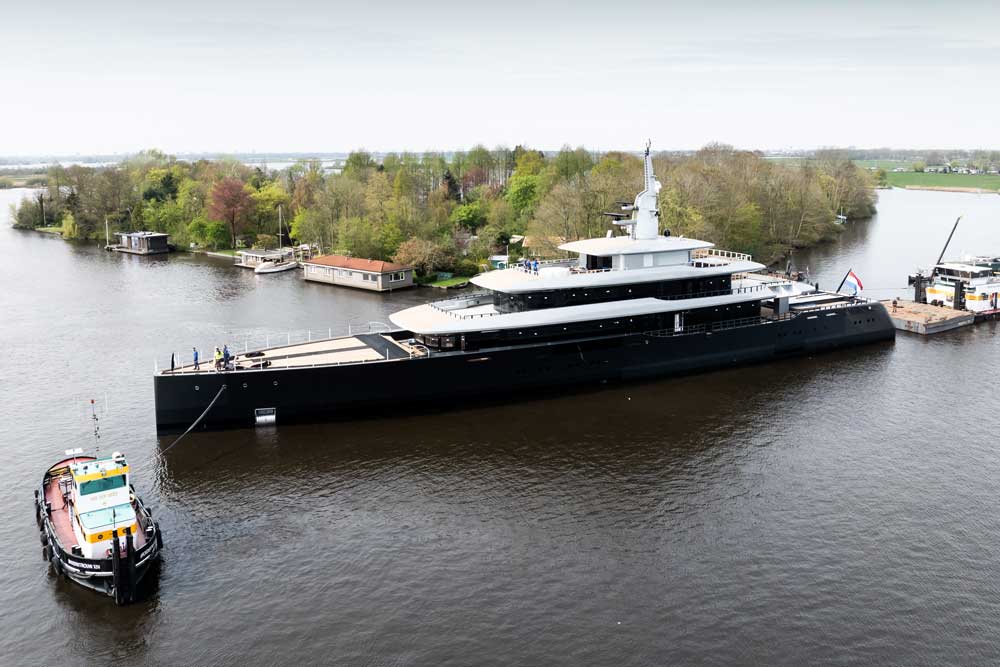






Feadship has presented Project 826, an 80 m superyacht concept that departs significantly from the yard’s established design language, combining new hull geometry with a series of technical solutions aimed at efficiency, structural optimisation and spatial openness.
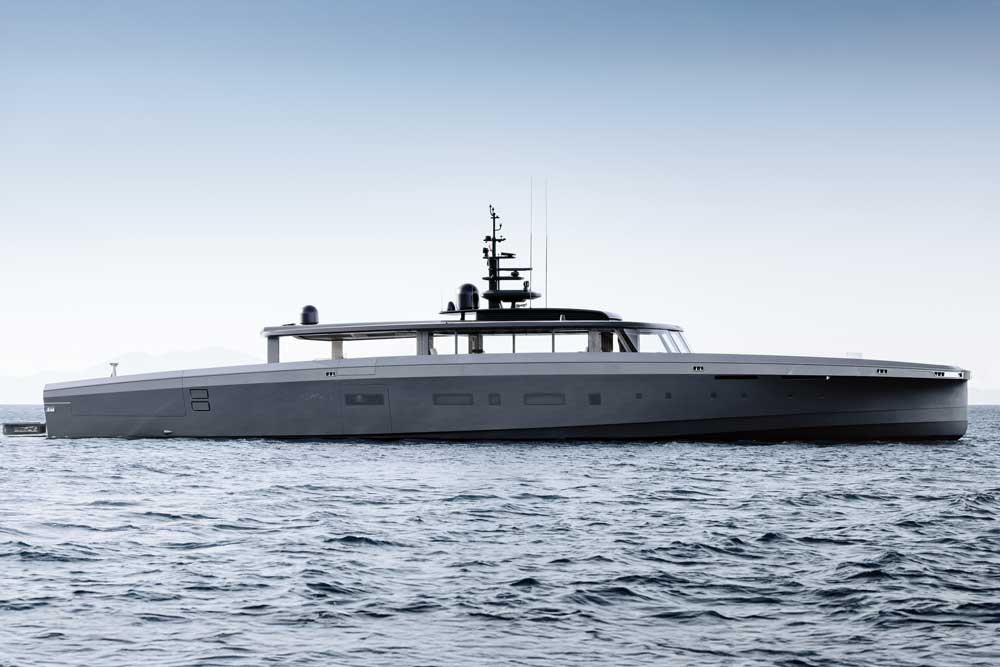
The yacht, designed by Malcolm McKeon, draws heavily on high-performance sailing yacht principles. A plumb bow and a hull that gradually widens towards the stern are intended to reduce hydrodynamic resistance and drag. The comparatively low freeboard and uncluttered foredeck further support this approach. The hull also features a subtle tumblehome, while the stern is characterised by a distinctive “waterfall” teak structure.
The superstructure is limited to two decks above the main deck. Extensive full-height glazing, combined with minimal structural interruptions, creates a high degree of transparency. From an engineering perspective, the integration of large glass sections while maintaining structural integrity is a key aspect of the design. Glass bulwarks and slim balustrades reduce visual and structural mass.
A central technical feature is the stern beach club. At 165 m², it is the largest ever realised on a yacht by Feadship. The space is arranged over two levels and incorporates large fold-out side platforms extending approximately 700 mm above sea level. To maximise opening widths and minimise structural obstructions, Feadship developed a new mechanical solution: the drive systems for the heavy hatches are integrated directly into the doors rather than housed in reinforced hull sections or stern pillars. This reduces blind spots and structural weight.
Above the beach club sits a 6.37 m swimming pool with a glass bottom. This configuration imposes additional requirements on load distribution and sealing, while allowing natural light to reach the space below. The aft arrangement is complemented by direct connections to watersports, fitness and wellness areas, whose side openings are also designed as fold-out platforms.
Forward on the main deck, the bridge, captain’s cabin and ship’s office are positioned with a clear view over a touch-and-go helipad, which can also be used as a multipurpose deck area. Two large tenders are stored in a forward garage, supporting weight distribution and freeing the stern for leisure functions.
The yacht’s technical outfitting follows a similarly reduced approach. Flat satellite receivers (Starlink) eliminate the need for bulky radomes, contributing to a lower centre of gravity and a cleaner profile. The sundeck features a minimal hardtop aligned with the horizontal deck lines.
Propulsion is based on a conventional diesel direct-drive system with shafts and propellers. Electrical power is supplied by three soundproofed generator sets from Scania, covering onboard and hotel loads.
With Project 826, Feadship combines established propulsion technology with new structural and naval architectural solutions. The concept focuses on hydrodynamic efficiency, reduced structural weight and maximum connection to the sea – parameters that are increasingly shaping modern superyacht design.