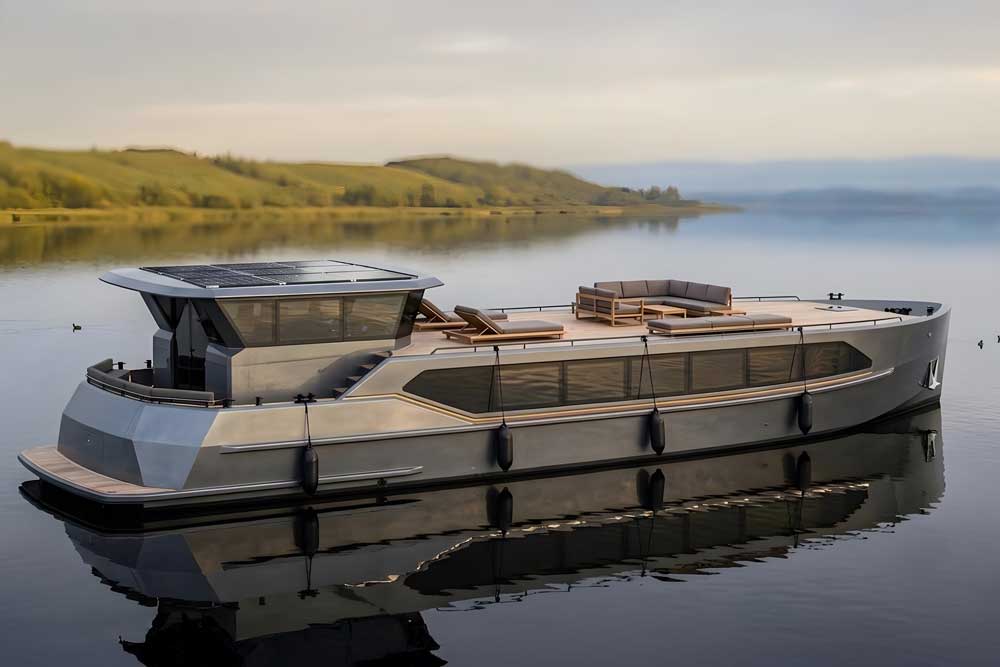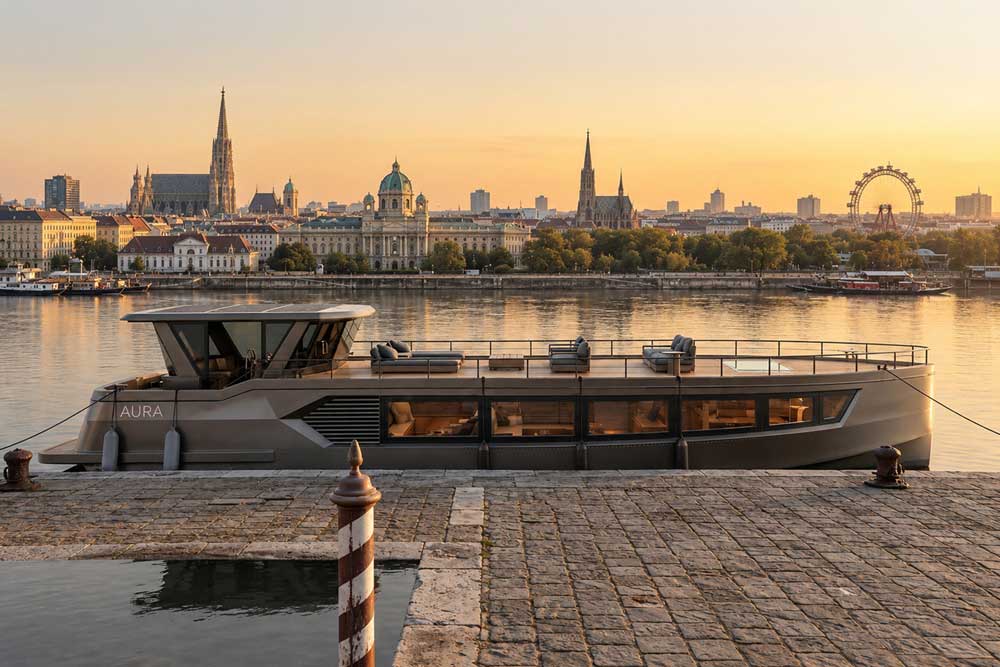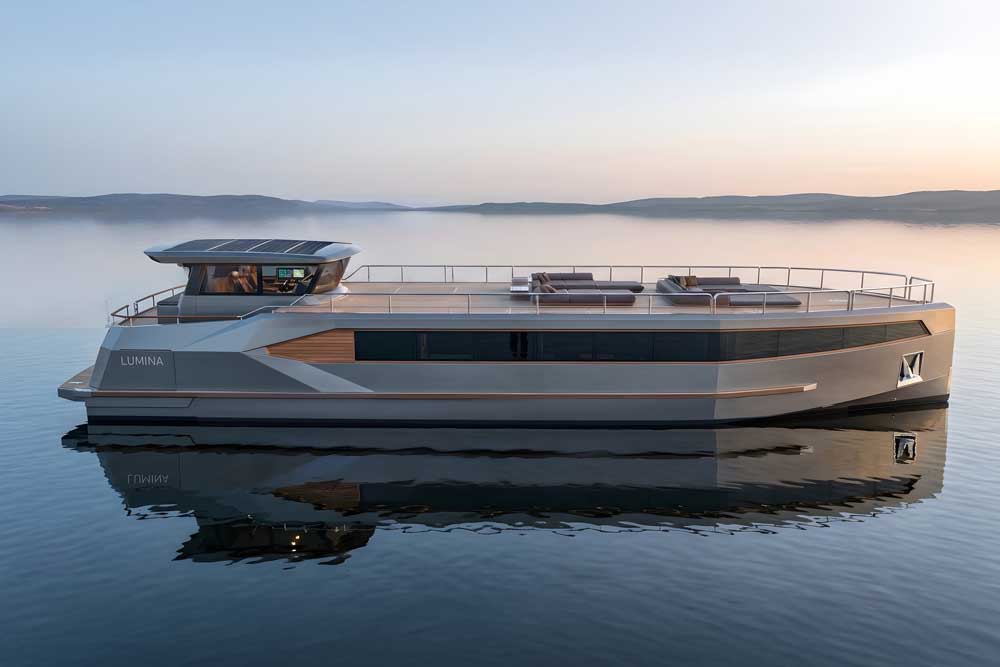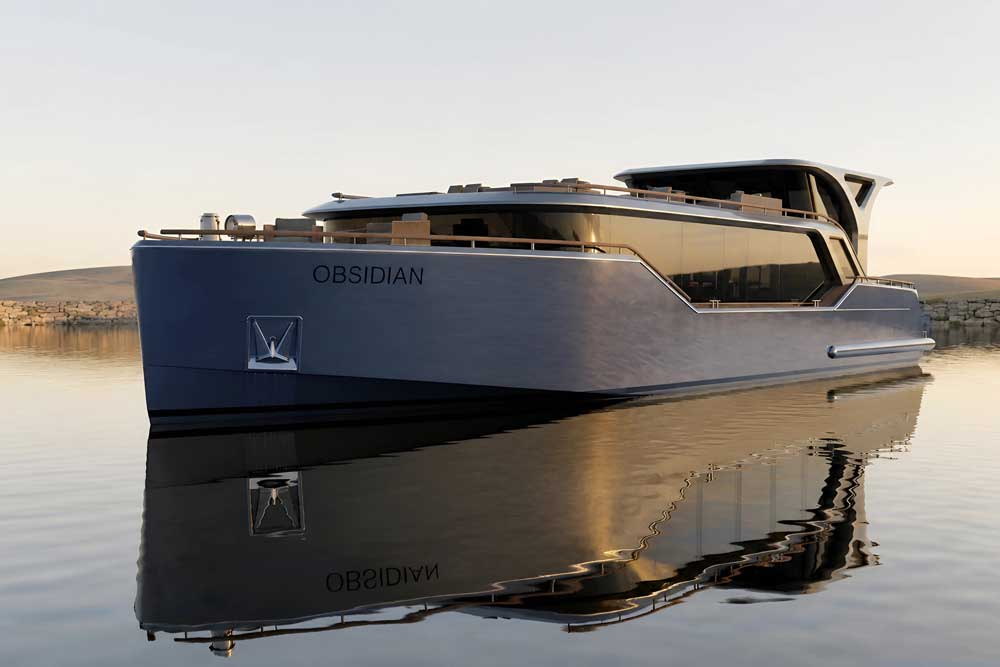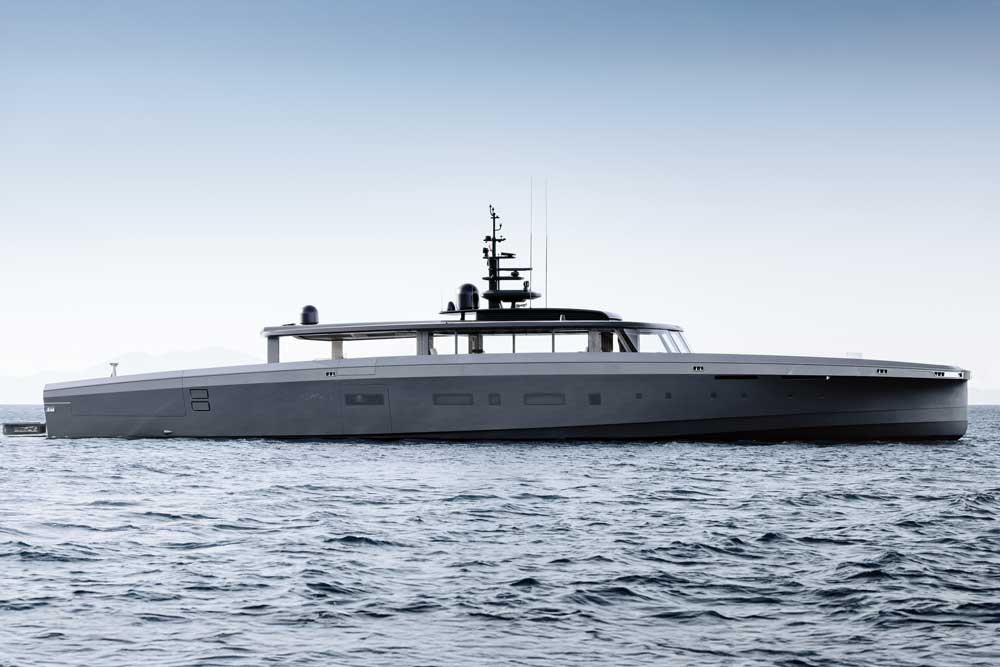






Italian designer Gian Paolo Nari and marine surveyor Lorenzo Cappugi have developed a new yacht concept based on the traditional European river barge. Four 19.90-metre models combine yacht-style living spaces with dimensions designed for Europe’s inland waterways.
The “Contemporary Barge” project aims to transfer contemporary yacht design and spatial concepts to a vessel type traditionally characterised by functional and relatively simple designs. The concept was developed by architect and yacht designer Gian Paolo Nari, whose previous work includes the exterior styling of the 59-metre explorer yacht “Akula”, together with marine surveyor Lorenzo Cappugi.
Italian Vessels shipyard in Termoli, also known as Cantieri Navali Termoli, has subsequently joined the project for the engineering and construction of the new platforms.
The initial range comprises four models – “Vega”, “Aura”, “Obsidian” and “Lumina” – which share the same basic platform but feature different exterior styles and architectural details. All measure 19.90 m in length with a beam of 4.85 m.
A key element of the design is the air draft. At a maximum of 3.40 m, the vessels are intended to comply with the European Freycinet gauge, allowing them to pass under historic bridges and navigate European inland waterways and canal systems.
Three of the models – “Vega”, “Aura”, and “Lumina” – feature a full-beam layout designed to maximise interior volume and living space. Obsidian is the only version equipped with traditional external side decks. All four designs incorporate a small aft swim platform inspired by modern superyachts.
Hybrid propulsion for inland and coastal cruising
The hull and bottom structure will be built in steel, while the pilothouse superstructure will be constructed in aluminium. According to the developers, the vessels are being engineered for CE certification in Classes C/B, allowing them to operate not only on inland waterways but also on coastal routes. This could, for example, enable a vessel to cross France via its waterways before undertaking shorter passages in Mediterranean coastal waters.
Propulsion is based on a serial hybrid system comprising two 80 kW electric motors and a 45 kW generator set. The system is intended to reduce emissions and enable quiet electric operation, particularly when travelling through urban areas or during manoeuvring.
The developers describe the concept as a “Floating Penthouse”, designed to combine the characteristics of a private residence with those of a yacht. The vessels are intended to be operated by their owners without the need for a permanent crew.
Another feature is the upper deck, which is structurally designed to accommodate touch-and-go operations by passenger drones or eVTOL aircraft.
Living space on two levels
The general arrangement is largely shared by all four models. The lower deck includes a saloon, dining area and galley as well as two cabins. The guest cabin can alternatively be used as an office, while selected layouts provide the forward master cabin with private access to a dedicated forward lounge deck. The engine room and tender garage are located aft.
A raised pilothouse at the stern is designed to provide 360-degree visibility during manoeuvring in narrow canals and when mooring. It also includes an indoor lounge and an exterior aft cockpit, while two side staircases provide direct access to the sun deck.
The upper deck is conceived as a large open-air relaxation area that can be configured and equipped according to the owner’s requirements.