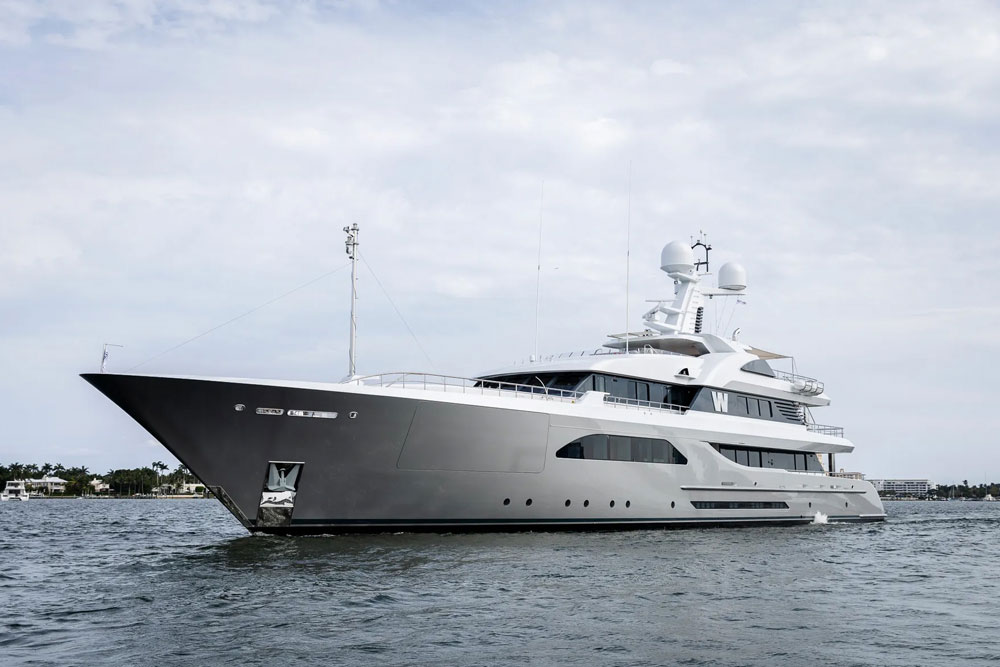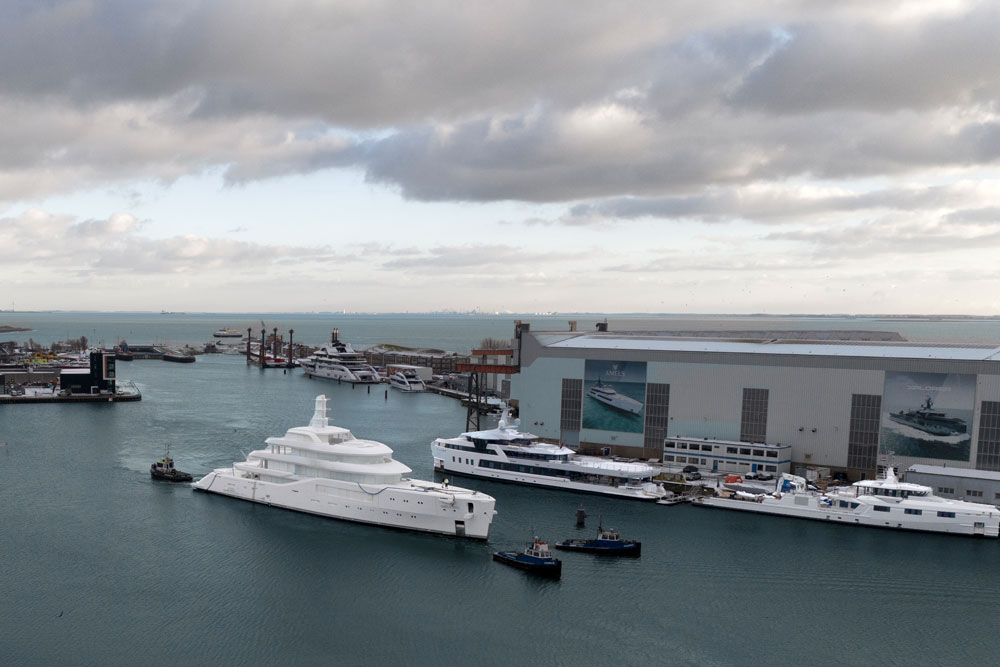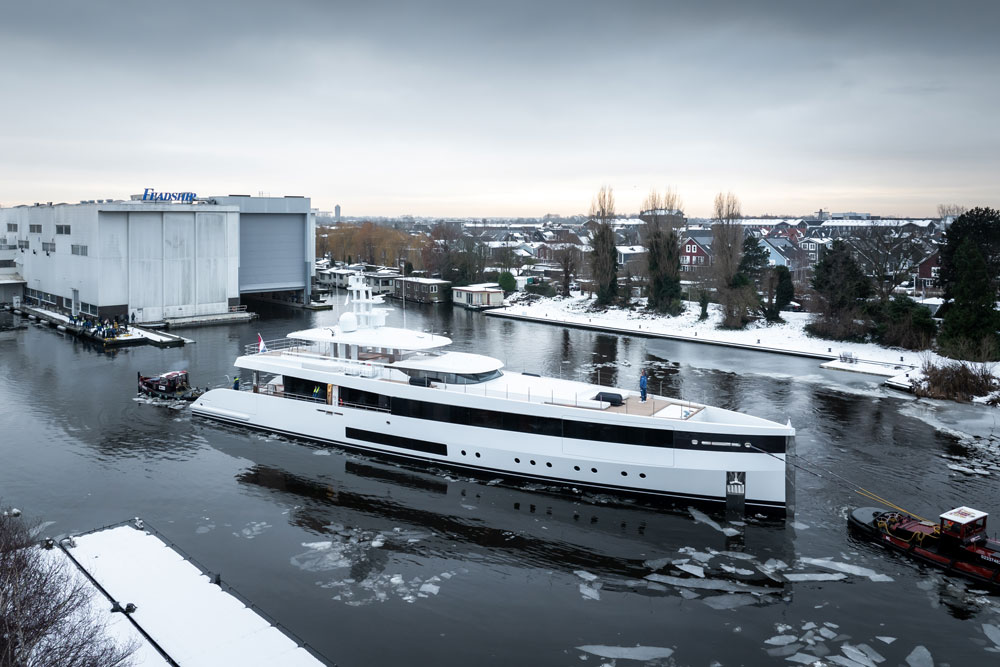
Cantiere delle Marche (CdM) delivered the yacht “Nasiba” last October. The IT and AV system for the Flexplorer yacht was supplied by Videoworks.
Delivering the equipment for the 44.5 m-long “Nasiba” was a particular challenge for the company, as the owner wanted a fully integrated IT and AV system capable of supporting long-term, offshore living for himself and his family. According to Videoworks, “Nasiba” is not a typical weekend or Mediterranean yacht. Instead, the owner wants to be connected around the clock – on the one hand for work and on the other for his children’s schooling.
Starlink on board
At the heart of the system is global connectivity. “Nasiba” is equipped with two Starlink terminals, port and starboard, to ensure uninterrupted coverage even if one antenna is blocked by the mast or superstructure. In addition, Videoworks installed two OneWeb LEO (Low Earth Orbit) antennas, providing a separate, fully redundant LEO network. This channel is designed to ensure that the yacht is always online.
This is already the second “domeless” yacht Videoworks has been involved in after the one-off “Project T” by Cantiere delle Marche. As LEO satellites are becoming a key technology for ubiquitous connectivity, especially in remote and underserved areas, this reflects an ongoing trend – both for newbuilds and superyacht refits.
For coastal operations, the yacht is equipped with 5G connectivity with a range of up to around 20 nautical miles, while 4G LTE covers shorter distances. All satellite and cellular links are routed through a Peplink Balance router with ultra-fast SpeedFusion technology, which dynamically aggregates and balances the connections. This means the available bandwidth across Starlink, OneWeb and 5G is automatically optimised.
The internal network is based on dedicated enterprise hardware, designed to deliver high reliability, user-friendly management and easy remote support. Redundant switches, swappable modules and failover paths have been installed throughout the yacht to ensure maximum uptime.
Electromagnetic fields minimised
At the owner’s request, who is mindful of electromagnetic fields (EMF), it is possible to switch off all Wi-Fi signals in the cabins at night in order to reduce exposure to electric and magnetic fields while sleeping.
For this reason, Videoworks hardwired every device where possible – from Ethernet connections and analogue audio signals to infrared-controlled televisions. According to the company, this was surprisingly complex, as almost all devices today rely on Wi-Fi. However, guests and crew can still use LAN ports or analogue connections for laptops, music and other devices even when Wi-Fi is disabled.
Modern AV system
As the long, explorer-style aft deck is used to store tenders and toys, the space has been designed as a flexible entertainment area: five high-power active speakers with subwoofers, a 98-inch motorised rear-projection screen that deploys from the deckhead overhang, and a projector housed in a portable flight case.
According to Videoworks, the area can be transformed from a casual deck into a full open-air cinema in just a few minutes. Audio and video signals are distributed via analogue RCA and balanced audio outputs to ensure compatibility with high-power external systems.
The CCTV system covers the entire exterior of the yacht, with camera feeds visible on all cabin TVs. A total of seven PTZ cameras mounted outside the vessel provide not only situational awareness and remote monitoring for the crew, but also a form of live video entertainment for the guests.
According to Videoworks, the “Nasiba” project shows how advanced IT, network and AV systems can be seamlessly integrated on an explorer yacht. Redundant connectivity, flexible entertainment, EMF-conscious design and a robust network architecture create a vessel that is fully operational, connected and user-friendly anywhere in the world.